Thursday, September 15, 2016

Narayan Dreaming, Vishnu Awakening

Wengenn in Wonderland
by Queenie Liao
from boredpanda


And when Narayan had first come into being, he briefly looked around, and then he slept.

Like all brand new children, unused to their new environment, planet Earth, he began his wake/sleep cycles as any infant would: short bursts of awake time with somewhat longer stretches of sleeping time. Awake, sleep, awake, sleep, with no regard for regularity. 

Unlike other child deities, however, when Narayan slept, he was the god Narayan and the whole world ceased to be in existence when his eyes were closed. When he awoke, he was the god Vishnu, and the whole world started the cycle of life, and of being, anew again. So it was, that the whole world and the birth/rebirth cycle was dependent on the sleeping patterns of Narayan/Vishnu.

This was troublesome, for as young gods grow, their sleeping patterns change, as all young children's sleeping patterns do. For the first few thousand years of Narayan's life, most of the world was left in darkness and the lifespans of all other living creatures was frequently cut short. (It is why today we have barely any recollection of the dinosaurs and those prehistoric men that roamed with the woolly beasts.) But soon, Narayan entered the phase of his Terrible Two-Thousand's -- that great, dreadful time when deity children refuse naps, refuse to go to bed, and refuse to sleep. 

This upset the normal rhythm of the world, and her inhabitants, and Kings and other living creatures soon began to live for hundreds, sometimes even a thousand years, before Narayan would finally sleep and reset the world again. During these awake phases, the Kings were able to  build great cities, pyramids, and monuments,  one that is even remembered to this day: Babylon. It was through the long period of time where human beings could erect for themselves something of greatness to honor their abilities and show off their intellect. The other gods watched on lazily and without worry, as these humans attempted to reach the heavens with their greatness, for they knew that soon, Narayan would enter into his teenage years, and a great long sleep would come, shutting the world into darkness for a time. 

As sure as even today the night sky comes faithfully to give us rest, Narayan entered into his Teenage years and slumbered. He slept long, he slept heavy, and for seemingly impossible lengths of time Narayan continued to snooze on as his body grew and he adjusted into his adult form. The world, today, briefly remembers this time period as the Dark Ages, that time which was lost to us and collective knowledge slipped away. 

It was during one of these Teenage years' awake periods that Vishnu, in his awake form, became somewhat self aware, and thus, aware that the world's birth/rebirth cycles seemed to be in sync with his own sleep patterns. He sought ought his best friend, who was ever by his side, Brahma, to seek confirmation in the observation. "Yeah, man, like, everything on the Earth ceases to exist when you sleep, Man... It's a little weird. You're just now realizing this?" Brahma confirmed to his friend, incredulously. 

Vishnu, armed with this new information, began to regulate his sleeping and wake cycles, for he was close enough to adulthood that he was able to control these things. He cut out caffeine, worked out regularly, got massages at night to help him sleep (thanks to his beautiful masseuse, Lakshmi) and created for himself a routine of waking Vishnu and sleeping Narayan.

And so, in this modern day, we have regularly spaced lifespans, a general understanding of the flow and rhythm of time and the length of days allotted to each of us, and a limit to the time we are allotted to grow, and expand, and share our wealth of knowledge with each other. 

Vishnu and Lakshmi on Shesha Naga,
from Wikimedia Commons


Author's Note: I learned about this fact of Narayan while he was sleeping/ Vishnu while he was awake from 7 Secrets of Hindu Calendar Art by Devdutt Pattanaik via Video Book form on YouTube. (Which is a great series, by the way! The Video Book format really makes it more digestable.)This chapter and episode was called "Narayan's Secret."

In it, it spoke of the world ceasing to exist while Narayan slept, in which he was Narayan, and the world coming to life again when he awoke, in his Vishnu form. I simply overlayed this story to the story of the world, attempting to link up historical markers with wake/sleep cycles as patterns of sleep of a boy who is growing to his adult form. In the traditional image of Narayan, goddess Lakshmi, his consort, is usually rubbing a foot, he rests on a Shesha Naga, and attached to his navel like an umbilical chord is the god Brahma, who sits on a lotus tree. I incorporated these characters into my version of the story as well.

Monday, September 12, 2016

7 Secrets From Hindu Calendar Art, Narayan's Secret: Reading Notes Chapter 2 / Part B EXTRA READING

7 Secrets From Hindu Calendar Art
by Devdutt Pattanaik
Chapter 2 -- Narayan's Secret
Via Video Book on YouTube

Narayan's Secret


  • Narayan is God. His deep slumber marks the dissolution of the world.
  • Rebirth of the world that exists/ ceases to exist cyclically as Narayan wakes/sleeps
    • No urgency in the world for Hindus like there is for Christians/Greeks. 
  • He sleeps above an Ocean of Milk which creativity is drawn out of when it is churned, just like butter is drawn out of milk when it is churned. 
    • Represents possibility (of creativity, of everything), the world is simply waiting to be churned
  • Adi Shesha, Ananta Shesha -- static, Narayan sleeps on time
  • Lakshmi and Narayan are pictured when he is ASLEEP, when he is AWAKE he is called Vishnu
  • Shiva is also pictured, showing the differences in lines on their foreheads: Shiva is 3 horizontal lines, Vishnu is two vertical lines meeting together between the eyebrows.
  • Garuda is Vishnu's mount -- still Shesha and flying Garuda 
  • Vishnu -----> Avatars to Human (Rama)
  • Creation is the result of Awareness, a subjective realization with each creation, something is destroyed (think baby on the choppy ocean waters and rebirth)
"What one considers the end is actually just a phase, a part of the process; after the end, comes the beginning." 
Hiker on a Journey
  • Death is a comma, not a full stop.
  • In Indian Art: 
    • Right Side: Soul, Intellect
    • Left Side: Movement, Matters, Emotions, Where the Heart is Located
Wengenn in Wonderland, by Queenie Liao
from boredpanda
I could create a story about Vishnu/Narayan as he grew and learned to sleep, as a child does... First they sleep a lot, which for Vishnnu, would cause the world to reset (rebirth) again and again and again, quite frequently. Then, when he would hit what would be equivalent to his Terrible Twos, and he refuses to sleep, the World does not get to reset or rebirth... and people begin to live for thousands of years, and Babylon happens, etc But, as Vishnu grows older, he learns to regulate his sleep, and has now attained quite a regular sleep pattern, that similar to that of an adult who has settled in to the pattern of life, and the World now rebirths, or resets, on quite a regular, predictable basis.


7 Secrets From Hindu Calendar Art, Reading Notes Chapter 1 / Part A EXTRA READING

7 Secrets From Hindu Calendar Art
by Devdutt Patanaik
Chapter 1 -- Ganesha's Secret
via Video Book on YouTube

The Divine Family Portrait
Shiva, Parvati, Ganesha and Kartikeya
I have seen this classic Divine Family Portrait loads of times -- but it had never really clicked in my head exactly who they all were. This video broke down exactly the family relations, and dove into a bit about who each God or god is as a person.
~

This week I started reading 7 Secrets From Hindu Calendar, by Devdutt Patanaik via Video Book on YouTube -- a much appreciated format! While the Video Book is narrated slowly enough, it still feels like a deluge of information being thrown at you -- and then stirred around with rhetoric questions which challenge the notion that anything at all in this world can be concrete. 


For example, Shiva's sons Ganesha and Kartikeya are challenged as to who might be the better son and win a prized mango by traveling around the world 3 times the quickest. Kartikeya travels around the whole world, and so represent physical might, while Ganesha went around his parents 3 times, who are, to him, his entire world. He embodies intellect and cunning. In supporting his claim, Ganesha tells Kartikeya, 
   
"Myth is an idea churned in my world; mythology is the set of stories, symbols, and rituals that communicate a myth."

Shiva

Most interesting was learning about Shiva. "When Shiva shuts his eyes, the whole world ceases to be, which is why Shiva is called the destroyer, and is considered God." [there are lesser gods and goddesses, spelling in English with lower-case g]

Shiva did not want to be a husband or a father, but when he opened his eyes (and spirit), he married Parvati. Ganesha represents the union of two opposites, the desire of his mother to have a family (Parvati represents material aspiration), and his father, who does not (Shiva represents spiritual aspirations). Ganesha also represents a mortal body and an immortal head. 

 It is important to note that "Brahma is male, and excludes the female form. It is an incomplete form, and thus implies the existence and need of a female, but where is she?" "She is the formless knowledge that is being transmitted.... She is called Saraswati." 

No man can create anything without Woman, not even God. She is the creator of the Vedas, and Brahma merely communicates it. 

4 Heads of Brahma = 4 Expressions of the Veda = 4 Goals of Life:
  1. Dharma -Righteous Conduct
  2. Artha - Economic Activity 
  3. Kama - Pleasurable Pursuits
  4. Moksha - Spiritual Practices
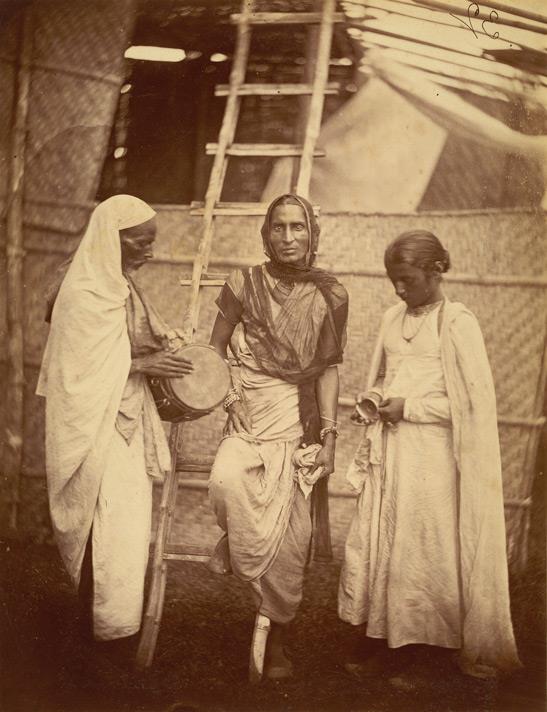
Bahuchara Mata - goddess of the Hijras

Hijra is the third gender, hermaphrodites who live on the fringes of society. Bahuchara once turned a woman into a man, allowing her to be a husband to the woman who was given to her as a bride. 
I saw a lot of Hijras when I was in Mumbai, and they would offer blessings to you after begging change off of you. If you met a Hijra, but did not give them something, then they would curse you. They are considered auspicious, and it is lucky if a group of them (or even one) visits your wedding party. I was unaware who their goddess was, precisely, however, until this video. 
A Hijra in 1860's Eastern Bengal,
via Wikimedia Commons

Sita Sings The Blues, Reading Notes Part B

Rama, Sita, Brahma, Agni and Shiva
from Sita Sings The Blues
via Wikimedia Commons
Finishing the second half of the movie, Sita Sings The Blues by Nina Paley, (available for free on YouTube!), one can't help but finish out the movie smiling.

One of the very last images of the film is Lakshmi getting her feet rubbed by Vishnu, as Chandra, the Moon God looks on. Lakshmi gives a little wink, as if to say that women can have the upper hand, if not at least an equal hand. This confirms the way that Sita portrayed her ending, by getting revenge on Rama. She is forced to prove her purity to him again, "Ok," she says, "I'll prove my purity, again, Rama," and she asks Mother Earth to take her back into her womb through a hole in the ground. Her two twin boys and Rama, as well as all of the onlookers are left stunned at what has just happened. I believe that Rama truly did love her, and probably would have taken her back had she survived another purity test, however, Sita decided to end it for herself once and for all, proving her own agency at work even in this ancient story.

Here is a pictoral representation of how we expect the story to go versus the actual ending of one of the stories of the gods, the Ramayana, as told in Sita Sings The Blues.

Parvati rubbing Vishnu's feet, at the beginning of Sita Sings The Blues
From spontaneousderivation.com

VS
Lakshmi getting her feet rubbed by Vishnu, near the end of Sita Sings The Blues
From New-Savana Blog
How the gods were depicted was also of interest to the overall style of the movie, and I enjoyed getting to learn the different physical markers of each that indicated who they were intended to be.

Nina Paley is a creator that I aim to learn more about, as I will seek out and listen to some of her talks, follow her blog, and anticipate the next body of work that she produces. She wins loads of brownie points for allowing her work to be accessible free of copy right restriction, specifically from this college student who struggles to pay for all of the price tags now associated with a modern education.

Sita Sings The Blues Video Notes, Week 4 Reading Notes Part A

Sita Sings The Blues Trailer, via YouTube

This week, I watched Sita Sings the Blues by Nina Paley. A modern twist on the retelling of the Ramayana, it presented the story as "The Greatest Break Up of All Time." And, it certainly was. In the end: Sita, in her own demure way, gets her revenge.

Most intriguing in this movie were the narrators that popped in and out of the movie to help move the story along. I found it really interesting that instead of just one narrator, as we are usually accustomed to booming over the movie with no physical form, these narrators were three, creating an interesting dynamic in discussion when events were questioned. They were also given simple, black forms stylized to that of an Indian god. I enjoyed hearing their memory of the story as the learned it when they were presumably younger, and how they argued over different aspects of the story, including discussion of modern moralistic values applied to a historical tale:

Ravana giving Sita 2 months to decide to be his wife, from Wikimedia Commons
(paraphrasing) "Why don't we applaud Ravana more for not forcing himself sexually upon Sita? At any point he could have just had his way with her, but no, if she wouldn't come to him willingly, then he wouldn't force her to. As much as we shouldn't have to applaud people for not raping other people, there is something missing from not noticing that he didn't just rape her."

This really helped spark the thought of how to re-interpret ancient tales in a modern way, using a single question applied to one of the characters to create a whole new framework where a story could be born.

I was incredibly pleased to have seen this movie, as Nina Paley's modernization to the Ramayana sparked ideas for my own story crafting, ten-fold. She hearkened Singing Sita to Betty Boop, she likened Rama to Johnny Bravo, she included her own modern day struggles, the narrators were simply having a conversation with each other, and Sita became the star instead of Rama and Lakshmanan. It certainly was a worthy watch for the reminder of how many different ways a story can be told if we allow ourselves to explore our creativity.

Friday, September 9, 2016

Reading Notes: PDE Ramayana Part D

Kumbhkarna needs to be fed!

  • These notes come from the Public Domain Edition of the Ramayana, part D, which can be accessed here.
Who Am I? Asks Rama,
 to which Brahma replies,


Then Brahma answered, "Hearken, thou whose virtue lies in truth! O Lord, thou art Narayana, bearing disc and mace; thou art the one-tusked boar; thou goest beyond the past, the present, and the future; thine is the bow of Time; thou art creation and destruction; thou art the slayer of all enemies, thou the forgiveness and control of passions; thou art the refuge of all gods and hermits; thou art manifest in every creature, in cows and brahmins, in every quarter, in sky and river and mountain-peak; a thousand limbs, a thousand eyes, a thousand heads are thine; thy heart am I, thy tongue Sarasvati; the closing of thy eye is night, its opening day. Sita is Lakshmi and thou Vishnu. And, O Rama, now Ravana is slain, do thou ascend to Heaven, thy work accomplished. Naught shall they lack whose hearts are set on thee, nor fail who chant thy lay."

Indrajit
·       “An equal battle raged until night, but the rakshasas waited for the night, and eagerly desired the setting of the sun, for night is the rakshasas’ time of strongest might.”
o   I could write a story from the perspective of the night, as she whispers and calls to the rakshasas, promising her coming, and promising that they will be strong when she comes to them.
o   Garuda’s Back from the Dead! Saves them from the magical arrows of Indrajit

Kumbhakarna – MASSIVE brother of Ravana who drank rivers of win. He defeated Hanuman and seized Sugriva and put him in his chariot. Rama sent flaming arrows towards Kumbhakarna and severed his head, leaving his flaming body to fall into the waves of the ocean.

Hanuman carrying the Medicine Hill –

Well, this isn’t fair – Rama’s getting help from the god, Indra, and his charioteer, Matali.
Rama cut off each of Ravana’s 10 heads, but a new one rose in each of its places, again and again and again. “Ravana’s death seemed no-wise nearer than before.” Ravana has a heart of iron, and it was pierced by one of Rama’s Brahma-arrows. Flowers fell down and celestial music was heard for Ravana’s death, which was the goal of the gods, and why the reincarnated Vishnu into a human form in Rama.

Mandodari’s Lament: She didn’t join him on the funeral pyre? His brother, Vibhishan lit the pyre, and Vibhishan is now King of Lanka.

Rama won’t take Sita back because her honor has been blemished by living in another man’s land for so long….. What?!

Thursday, September 8, 2016

The Secret Shared by Mount Mainaka and Hanuman

Hanuman, a street print purchased in Delhi, India.

   With the monkeys and the bear filled army gathered round, great Jambavan told to all within earshot the tale of Hanuman's birth and his birthright.

   "Born of the Wind God, Vayu, were ye, Hanuman, to your mother Anjuna, when she was in labor with you among the mountains. And as you grew, your friends were the mountains, the trees and the forest. You had no fear of the Sun, but thought it to be another fruit in the sky for your pleasure. Oh, Hanuman! You were convinced it was in reach for you! How merrily you learned to spring forth then,  youthful Hanuman, when you were reaching for the Sun -- 3,000 leagues you taught yourself to reach. So, what then, is 100 leagues across the sea to Lanka, when as a young boy you taught yourself to leap 3,000? Remember, Hanuman, that it was you who befriended the mountains, and the forests and wanted the Sun for yourself. The Ocean, then, is a friendly Ocean, and surely she, too, will befriend you in your journey to Lanka. Fear not the creatures in her depths, but ask her to aide you in your righteous and noble journey. For you, Hanuman, this journey was designed, and it is why you are aligned with Sugriva in Rama's task to retrieve Sita to her rightful place beside her husband. Gather yourself, Hanuman, and race forward to gain back that which is rightfully Rama's!"

   The monkeys howled and began jumping up and down, clapping, and stomping their feet. The youthful among them raced to a forest grove a little ways off, and began leaping into the trees and back down, as their excitement for Hanuman rose into a swell that overtook the army. The bears moaned, raised onto their back haunches, front paws in the air clapping, and snorted their snouts in approval.

    Hanuman, being reminded of his birth and who he was, gathered himself together: he wove tight his inner strength in his core, sparked the fire of success in his mind, stomped his feet to warm them up for the journey ahead and roared with all his breath the great howl of a howler monkey. The army roared and cheered back their approval. Confidence gathered, Hanuman wheeled back up the mountain Mahendra just behind them that overlooked the ocean. Prepared for the hard task ahead, and his innerself aflame with the knowledge that this was a task he alone could complete, he shook the mountain, preparing his body for his leap. Muscles taught, he bounded down the mountain, feet spinning as fast as flames, tail afire with the speed from which he went, past the army on the shore and over onto the Ocean waters he spun. He was not sinking, in fact he was making as good of speed over the Ocean as he was over the land. Using the waves as footholds to push off of, he pressed on towards Lanka.

   On his way, however, he began to grow tired. For the wave-like footholds he thought were giving him advantage in moving forward were in fact slowing him down. His might pushed through the water, instead of responding to and pushing off of a hard surface, such as a mound of land or tree limb, as he was accustomed to. "Oh, this shall be harder than I expected," thought Hanuman. "Jambavan was wrong... I am a friend to the land dwelling places, but I am no friend to the Ocean, and she is no friend to me." As the spark of confidence in his mind faltered, so too did his feet, and his pace slowed.

   Knowing there was a strange new creature in her midst, the Ocean had been watching Hanuman curiously. He was not diving down into her waters, but was merely brushing her surface. She was accustomed to creatures swimming down into her depths, and enjoying the feel of the play of movement among her inner waters, and she changed her waves to play with Hanuman's feet, washing this way and that in unexpected directions. It was to Hanuman's hindrance, in fact, that she did this, but she did not know that he was about the hard and noble task of reaching Lanka to rescue Sita. Inferring that he was in fact tiring, and not understanding her playful methods, the Ocean grew worried for Hanuman, and called to Mount Mainaka to come and give rest to the land creature who had lost his way amongst the top of her waters.

    Mount Mainaka responded happily to the Ocean's bidding, for she had been banished from roaming about where she pleased on the landmasses, but had been given free reign to move as she desired among the Ocean and her friends. The Ocean rarely called for her, so this time when she did, she came quickly. Hearing about this lost Hanuman above the waters, Mount Mainaka raised up under Hanuman's feet and moved with him as he continued traveling forward, for he did not realize that land had suddenly sprung up underneath him where water should have been.

    Finally, as Mount Mainaka matched Hanuman's speed, he realized he was no longer pushing against moving currents and difficult water, but that he was in fact back up on land again. "It has not been 100 leagues, yet" Hanuman wondered out loud to himself, "How then, are my feet finding solid ground again?"

   "Hello Hanuman! How have you been all of these years? It's been so long since I have seen you! We used to play together when you were little, do you remember? It's so good to see you, but tell me, what are you doing out here away from land's edges and on the Ocean waters?"

   Hanuman, thinking to himself of Jambavan's words that he is a friend to the mountains, and to the trees, besought Mount Mainaka for assistance in reaching Lanka. For he was growing weary, and his legs were feeling heavy.

    And Mount Mainaka, pleased with being reunited with an old friend who has grown to adulthood and now aims to achieve a noble deed, agreed to help Hanuman by carrying him on her Mountaintop, through the waters, and over to Lanka so that he may retrieve the beautiful Sita.

Author's Note: This story was an adaptation of "Hanuman's Leap", a translation from Myths of the Hindus and Buddhists by Sister Nivedita, available in the Public Domain Edition of the Ramayana.


   Sugriva's monkey and bear army is downtroddn, for they have searched the lands and cannot find the beautiful Sita, whom has been taken from Rama. They cannot go over the waters to the island of Lanka where they have been told she is kept, and they are unsure of what to do next. Then, Jambavan tells Hanuman that he is capable of traveling the 100 leagues over the sea to Lanka when all the others will tire and grow weary. An ocean dwelling Rakshasi does come to take Hanuman in the original telling, but I ommitted that to play up the interaction between Hanuman and Maint Mainaka. In the original, Mount Mainaka rises up to give him rest in her forest and on her lands, offering fruits for him to replenish hi energy with. Hanuman ignores Mount Mainaka and continues on his arduous quest towards Lanka. Having read some backstory on Mount Mainaka's boon to be granted the ability to travel where she wishes, but only in the Ocean, and having been banished from traveling where she wishes on land, I thought it would be a more interesting tale to see the interactions between Mount Mainaka and Hanuman. I leave it as a secret between them that she, Mount Mainaka, was in fact the one who got Hanuman across the sea to Lanka, which is my own addition to the story.